

Although a cultural hub, the original Globe often fell victim to the usual Medieval annoyances such as censorship, vandalism, and a lengthy closure due to the spread of the bubonic plague.
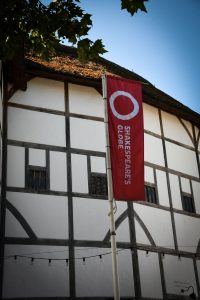
In 1613 The Globe Theatre burst into flames during a performance of Henry VIII as a cannon was set off as part of the staged drama. The Globe was rebuilt a short time afterward but ultimately destroyed by Puritans who disapproved of the playwright decades after he had died. For the memory of Shakespeare’s Globe, all seemed lost until nearly four hundred years later when American Actor Sam Wanamakers “Globe Trust” finished the construction of “Shakespeare’s Globe” along the riverside in Southbank.
The reconstruction was carefully researched so that the new building would be as faithful a replica of the original as possible, and to this day, The Globe has the first and only thatched roof permitted in London since the Great Fire of 1666.
Today, Shakespeare’s Globe does not hold its relevance from simple history alone. Since 1997, the theatre has become a cultural institution independently, producing both a summer and winter season, as well as classes, tours and exhibitions for theatre goers and historians.
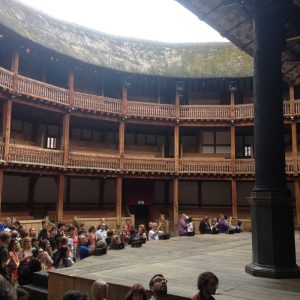
As a bit of old world theatre, in the heart of modern London one of the most popular attractions at The Globe is their summer Shakespeare series. Guests have the option to purchase a seat, and view the play as nobility would have in Shakespeare’s time. Alternatively, and for only £5, guests can stand in “The Groundlings” as close to the stage as they would like, and get an up close experience to some of Shakespeare’s greatest works.
This legendary theatre is not only a must see for theatre lovers, but anyone visiting London who wants to experience the best of modern theatre, combined with the history of days gone by.
For an amazing tour of the globe and other Top London attractions, click here!